
Here are all our answers to questions about the wind in Gran Canaria, including the most popular one: Is it really that windy?
We share with you the best months, the best locations and our tips for managing your vacation in the wind!
This opinion is completely independent, based on our experiences. We visited the region anonymously, making our own choices and paying our bills in full.
Is it very windy in Gran Canaria? Quick answers
Is it very windy in Gran Canaria?
Yes, Gran Canaria can get windy, but not as much as its neighbor, Fuerteventura. It is windy there for much of the year, especially along the exposed coasts. It is generally a welcome way to cool down the hot air. In our opinion, it doesn’t ruin the vacation, except during a few more intense episodes.
The island’s mountainous terrain (Pico de las Nieves rises to 1,949 meters) creates shaded areas and shelters certain valleys. So you’ll be able to find sheltered spots, unlike in Fuerteventura, where the wind blows almost everywhere.

How windy is it in Gran Canaria?
The prevailing wind on Gran Canaria comes from the northeast (trade winds). Its intensity varies depending on several factors:
- your location on the island (the north coast is windier than the south coast)
- the time of year (windier in the summer)
- altitude and valley topography
- the time of day (stronger winds in the afternoon)
On average, wind speeds range from 15 to 30 km/h along the coast. We’ve found that there really are some very quiet days, especially in the fall and spring.

Why is Gran Canaria so windy?
Like all the Canary Islands, Gran Canaria is influenced by the trade winds. These steady winds are blowing from the Azores High. The daytime warming of the land also creates local breezes: warm air rises over the land, drawing in cool sea air.
The mountainous terrain plays a dual role. It blocks the wind on the northern slopes, creating calmer areas to the south. On the other hand, it speeds up traffic flow in narrow passages. We’ve noticed that the Maspalomas area is often less windy than the north coast around Las Palmas.

OUR ADVICE FOR RENTING A CAR IN Gran Canaria
- Compare prices on our preferred platform: DiscoverCars – one of the best rated sites.
- If you’re planning to explore the mountains, don ‘t take the smallest cars. A more powerful engine will be more comfortable.
- But don’t take too big a car either, as some roads are narrow.
- There’s a lot of demand and it’s an island, so book early.

The Windiest Seasons in Gran Canaria—When to Travel to Avoid the Wind
What is the windiest month in Gran Canaria?
July and August are generally the windiest months. The trade winds pick up in the summer, making the high temperatures more bearable. In fact, this is the perfect season for board sports like windsurfing and kitesurfing, especially in Pozo Izquierdo, a world-famous spot. Or Playa El Hombre in Telde, a favorite among surfers and water sports enthusiasts.
We had some summer days with a steady breeze, but that never got in the way of our outings. The wind rarely blows continuously at full strength all day long.

What is the least windy month in Gran Canaria?
September, October, and November are known to be less windy. The sea remains warm, temperatures are pleasant, and tourist crowds are thinning out now that school has started. In our opinion, this is the best time to enjoy the beaches without being bothered by the wind.
Please note: These trends are averages. There may be annual variations. We can’t guarantee perfectly calm weather, but the chances are high.

Is Gran Canaria windy in the winter?
Winter (December through February) is less windy than summer, but occasional gusts can occur. A typical winter day in Gran Canaria is like a beautiful European spring day: sunny, mild, and sometimes with a light breeze. The wind isn’t usually cold, except at high altitudes.
Is the wind cold?
No, the wind isn’t cold by European standards. Even in winter, the air temperature rarely drops below 14°C (57.2°F) at night along the coast. During the day, winter lows hover around 18°C (64.4°F) along the coast. The wind can make it feel cool, but a simple sweater or a light jacket is enough in the morning and evening.

WHERE TO STAY IN Gran Canaria
Our independent picks for the accommodation of your dreams:
- Where to stay in Gran Canaria
- Our favorite: Marina Suites Hotel
Select by hotel type:
- 5-star hotels
- Best boutique-hotels
- Best adults-only hotels
- Best all-inclusive hotels (coming soon)
- Best hotels for families
Select by city:

Where to go? Areas and beaches with no wind in Gran Canaria
The least windy area of Gran Canaria
The southern coast of Gran Canaria is significantly less windy than the north. The central mountains (at an elevation of about 1,900 m) block the trade winds coming from the northeast. The beach resorts of Maspalomas, Playa del Inglés, Puerto Rico, and Puerto de Mogán enjoy a milder microclimate.
We have read that the Maspalomas area is often cited as the least windy part of the island, and our experience confirms this. Inland valleys such as Tejeda or San Bartolomé de Tirajana may also be sheltered, but watch out for clouds clinging to the peaks.

Is Gran Canaria too windy for sunbathing?
Generally, no. On the south coast, you can relax undisturbed most of the time. Sometimes the wind picks up in the late morning, but it remains moderate. We’ve had a few windier days, especially in the summer, but they don’t last long. If you’re sensitive, choose an urban beach with buildings or dunes to shield you.

Which beaches in Gran Canaria are sheltered from the wind?
Here are the beaches where the wind is least noticeable:
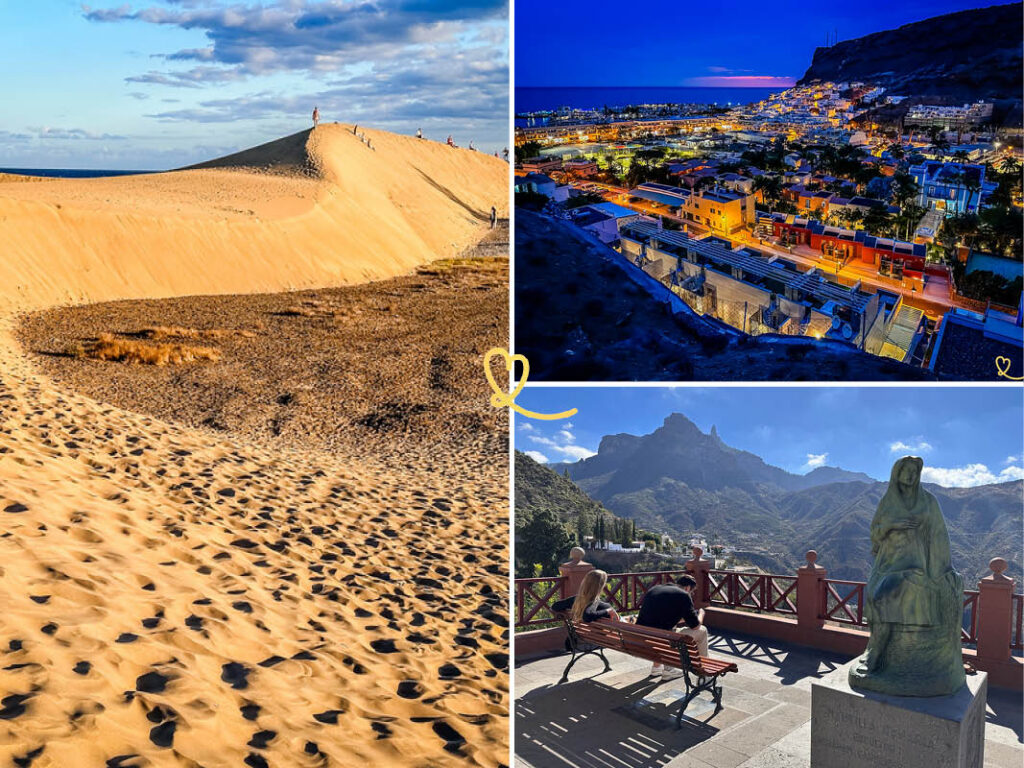
- Maspalomas Beach (sheltered by the dunes and buildings)
- Playa de Puerto Rico (located in a small, sheltered cove)
- Playa de Amadores (a very sheltered artificial bay)
- Playa de Mogán (sheltered harbor, very light wind)
- Las Canteras Beach in Las Palmas (protected by a natural reef, though the northern part of the island is windier)
Discover our selection of the most beautiful beaches in Gran Canaria.

Find where to go each day based on the wind
Our advice: Don’t let the wind distract you too much. It’s part of the charm of the Canary Islands. But if you want to make the most of your days, use the windy.app app. There you’ll see maps showing hourly forecasts of wind speed and direction.
In practice, when the wind is blowing from the northeast, head to the southern or western beaches. If the wind is coming from the south (which is less common), head north. We often switched beaches throughout the day to find the best conditions.

FUN in Gran Canaria:activities
Dolphin watching
Buggy / Quad
Snorkeling
Kayaking in the Mogan caves
But also: Canyoning, Horse riding, Via Ferrata, Coasteering… See all options

Tips for Dealing with Wind
Natural shelters and rocks
On some beaches, you’ll find rock formations or small cliffs that block the wind. Take shelter with them. In Maspalomas, the dunes themselves provide sheltered nooks. Warning: Building new stone shelters is prohibited; please respect the environment.

Protected deckchairs
In beach resorts, sun lounger rentals are sometimes set up behind canvas or bamboo windbreaks. Ask at the beach huts. In Playa del Inglés and Maspalomas, we saw areas equipped with permanent windbreaks.

Towel Clips
A simple but handy accessory: large clothespins to hold your towel in place on the lounge chair. Even when there’s no wind, it’s handy for keeping it from slipping. You can find them at local supermarkets.
Small clothespins for drying
All hotels and apartments have a clothesline on the balcony. To keep your swimsuits and towels from blowing away, bring a few small clothespins. It’s a small gesture that will save you a lot of trouble.
Sun cream
Don’t be fooled by the cool sensation brought on by the wind. The sun is very strong in Gran Canaria, especially near the beaches, where the sand and water reflect the sun’s rays. Apply sunscreen with a high SPF (SPF 50+) and reapply it every two hours.
What is calima?
The calima is a meteorological phenomenon unique to the Canary Islands. It is a warm wind carrying sand and dust from the Sahara. It brings dry heat, reduced visibility, and a yellow or orange tint to the sky.
This episode usually lasts 2 to 5 days, rarely more than a week. During an intense calima, it can be unpleasant to go outside, especially for people with sensitivities (allergies, respiratory problems). We experienced a moderate calima: the landscape takes on a mysterious quality, but outdoor activities are still possible. Remember to stay hydrated and protect your eyes.

Other frequently asked questions
Which is the windiest Canary Island?
Fuerteventura and Lanzarote are considered the windiest. Thanks to its mountainous terrain, Gran Canaria is generally less exposed than its two eastern neighbors. Tenerife and La Palma are even more sheltered along their southern coasts.
Is Maspalomas windy?
Maspalomas is one of the least windy areas in Gran Canaria. The dunes and buildings provide natural protection. You’ll find plenty of quiet days there, especially in the fall and spring. Check out our article on things to do in Maspalomas on windier days.

Is Las Palmas windy?
The capital, located on the northeast coast, is more exposed to the trade winds. There is often a steady breeze, but Las Canteras Beach remains pleasant thanks to its reef, which breaks the waves and reduces the effect of the wind. See our article on things to do in Las Palmas.

Is Puerto de Mogán windy?
Puerto de Mogán, at the southwestern tip, is very sheltered. The harbor is nestled between cliffs, and the beach is located in a small bay. It’s one of the quietest places on the island. Perfect if you’re looking for a completely windless environment. Check out our guide to things to do in Puerto de Mogán.
PLAN YOUR TRIP TO Gran Canaria
- Best of
Best things to do in Gran Canaria
Most beautiful landscapes
Most beautiful towns and villages
Most beautiful beaches
Best natural pools
Archaeological sites
Best museums
Best boat tours
Secret places, off the beaten track

- Practical advice
25 tips for a successful trip to Gran Canaria
When to go?
How to get around
How to rent a car in Gran Canaria
Driving tips
Best excursions
Itineraries: 3 days – 4 days – 5 days – 6 days – 7 days – 10 days


SHE MADE THE TRIP Claire