
Passionate about archaeology? The Cenobio de Valerón awaits you in Gran Canaria! It’s a troglodyte site, carved out of volcanic rock. It is one of the most impressive remains of the Canaries’ aboriginal civilization. We were captivated by the sheer scale of this pre-Hispanic collective granary, made up of over 300 cavities carved into the cliffside. A timeless place that bears witness to the ingenuity of the Guanche people.
In this article, you’ll find our photos and useful tips for making the most of your visit to Cenobio de Valerón!
This opinion is completely independent, based on our experiences. We visited the region anonymously, making our own choices and paying our bills in full.
Why visit Cenobio de Valerón?
Is Cenobio de Valerón worth it? Our opinion:
Without hesitation! Cenobio de Valerón is a unique archaeological site. This pre-Hispanic collective granary, carved out of the volcanic tufa of a huge natural vault, is a striking testimony to the life of Gran Canaria’s ancient inhabitants.
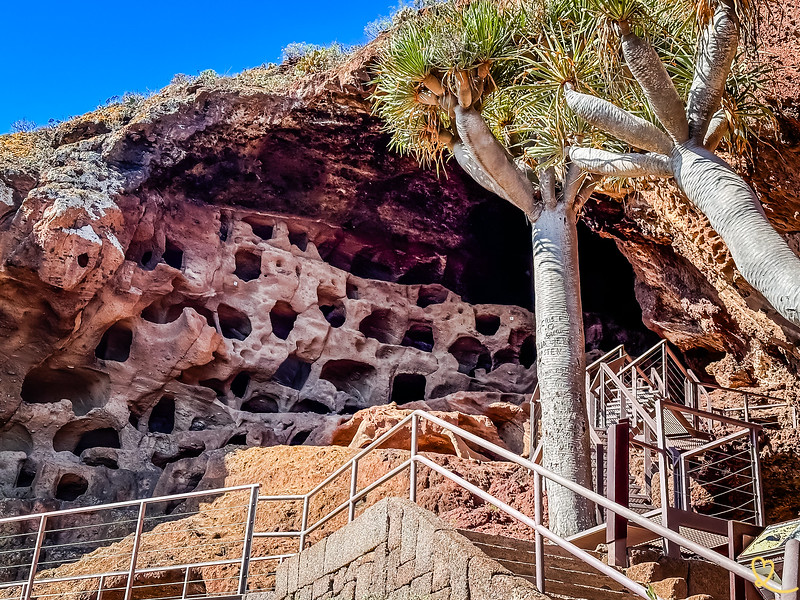
We were impressed by the concentration of over 300 silos cut into the rock, arranged on several levels. The natural setting, perched high up in the municipality of Santa María de Guía, adds a spectacular dimension to the visit. This is one of the best sites in Gran Canaria!

Why is Cenobio de Valerón famous?
The Cenobio de Valerón owes its fame to its status as the largest aboriginal collective granary in the Canary Islands. It was dug into a natural volcanic arch nearly 30m high, and contains over 300 cavities!
These cavities were once used to store cereal crops, mainly barley and wheat. The site has been classified as a Site of Cultural Interest since 1978. For a long time, legend attributed the site to a convent of young priestesses called harimaguadas, hence the term “cenobio” (monastery). We now know that this hypothesis was rejected by archaeologists in favor of the function of a communal granary.
Our favorite moments
Here are the 3 most memorable moments of our visit:
- The gradual ascent to the site, gradually revealing the immense natural vault sheltering the hundreds of cavities. A breathtaking spectacle!
- A close-up look at the silos, where you can still make out the grooves for the wooden doors that closed each cavity.
- The panoramic view from the belvedere over Gran Canaria’s north coast and the Atlantic Ocean is the reward for the climb.

History in brief
Cenobio de Valerón has a fascinating history. Here are the main steps to remember:
- Pre-Hispanic era (before the 15th century): the Canarian aborigines, descendants of the Berber populations of North Africa, dug a vast collective granary in the volcanic tuff to store their cereal harvests (barley and wheat). The site is managed by the community.
- 15th century: the Spanish conquest of Gran Canaria (completed in 1483) put an end to the use of the granary by the aboriginal population.
- 17th-19th centuries: the site falls into oblivion. Chroniclers and travellers begin to mention it and associate it, wrongly, with a “convent” of Guanche priestesses(harimaguadas).
- 1978: Cenobio de Valerón is classified as a Site of Cultural Interest (SCI), guaranteeing its heritage protection.
- Contemporary period: the site is developed for visitors and becomes one of Gran Canaria’s major archaeological attractions.

WHERE TO STAY IN Gran Canaria
Our independent picks for the accommodation of your dreams:
- Where to stay in Gran Canaria
- Our favorite: Marina Suites Hotel
Select by hotel type:
- 5-star hotels
- Best boutique-hotels
- Best adults-only hotels
- Best all-inclusive hotels (coming soon)
- Best hotels for families
Select by city:

Access and map: Cenobio de Valerón, Santa María de Guía
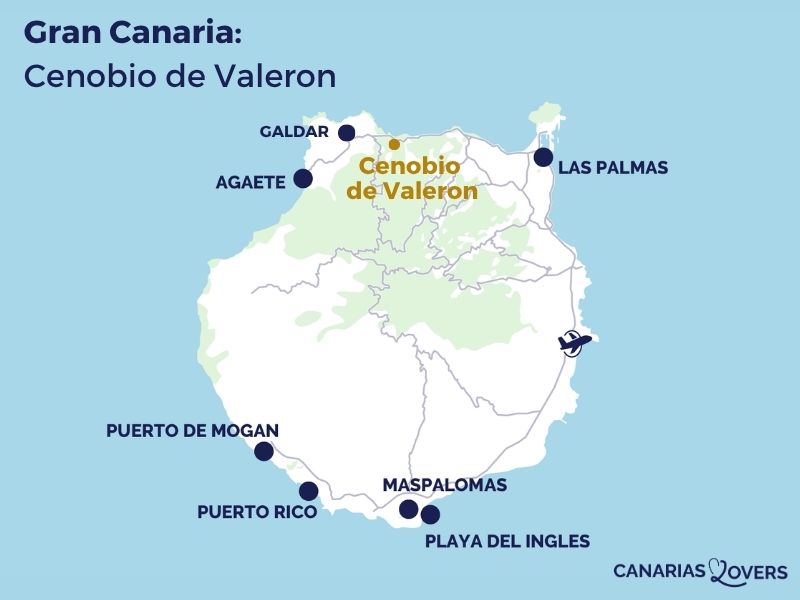
Where is the Cenobio de Valerón?
- In the municipality of Santa María de Guía, north of Gran Canaria,
- Driving time from Las Palmas de Gran Canaria: 30min
- Driving time from Gáldar: 10min
- Driving time from Arucas: 20min
Our map will help you find your way around:
How to get there?
There are several options for getting to Cenobio de Valerón:
- The car: the most practical way. From Las Palmas, take the GC-2 freeway heading west, then take the Santa María de Guía exit. The site is then signposted. The road is in good condition.
- Public transport: Global buses serve the municipality of Guía. From the nearest stop, however, it’s a 20-minute walk uphill to reach the site. Ask your local transport network for timetables.

OUR ADVICE FOR RENTING A CAR IN Gran Canaria
- Compare prices on our preferred platform: DiscoverCars – one of the best rated sites.
- If you’re planning to explore the mountains, don ‘t take the smallest cars. A more powerful engine will be more comfortable.
- But don’t take too big a car either, as some roads are narrow.
- There’s a lot of demand and it’s an island, so book early.

Parking
A small free parking lot is located close to the site entrance. Places are limited; we recommend arriving early, especially in high season, to be sure of finding a seat.
As you can see in the photo below, it’s really quite limited!

Useful tips: duration, schedules, eating…
Best time to visit
The Cenobio de Valerón is open-air. We recommend early morning, when the light highlights the rock cavities and the heat is still bearable. Avoid the hottest hours of the day in summer. Outside the summer season, visitor numbers are much lower and you can enjoy the site in complete tranquillity. For our part, we were lucky enough to discover it one weekday morning, almost on our own.
Length of visit and main difficulties
Allow between 30min and 1h to visit the Cenobio de Valerón, including explanatory panels. The route includes a staircase leading up to the caves. The climb is moderate but can be slippery in wet weather. We recommend you wear comfortable shoes. Unfortunately, the site is not accessible to people with reduced mobility due to the stairs and uneven terrain.

Advice on how to visit
The route is linear and well-marked. From the entrance, a path leads to the first viewpoint, offering a panoramic view of the attic. Then continue up the steps to get closer to the cavities. Information panels along the way explain how the granary functioned, the life of the Aborigines and the various archaeological hypotheses. We suggest you take the time to read each panel to better understand what you’re looking at.

Visiting with children
The Cenobio de Valerón will appeal to curious children thanks to its “cave” aspect and the spectacular cliff face. However, the visit remains essentially contemplative, and the explanatory panels are intended for an adult audience. We didn’t notice any dedicated play equipment for younger visitors. Beware of staircases; it is essential to supervise small children.
Schedules and rates
- The Cenobio de Valerón is open Tuesday to Sunday, 10am to 5pm in winter and 10am to 6pm in summer.
- The site is closed on Mondays.
- Price: 3 euros
- Visit the official website for more info here.
Guided tours
The tour is self-guided, with explanatory panels along the way. They are written in Spanish and English. Guided tours may be organized from time to time by the Cabildo de Gran Canaria; check with your local tourist office for dates and availability.

Catering
There are no catering facilities on the Cenobio de Valerón site.
An impressive collective attic
The Cenobio de Valerón is striking for its sheer size. The immense natural vault, almost 30m high, shelters a dense network of cavities carved into the volcanic tuff. The closer you get to the site, the more striking its dimensions become. For our part, we were struck by the contrast between the roughness of the rock and the precision of the carving. Each silo has its own shape, adapted to the relief of the wall.
Silos and their functions
The more than 300 silos that make up the Cenobio de Valerón were used to store crops, mainly barley and wheat. Each cavity was closed by a wooden or stone door, the grooves of which can still be seen carved into the rock. This system enabled the various families in the community to store their grain safely, away from moisture and pests. We observed that the silos were laid out on several levels, accessed by a system of holds cut into the wall that acted as steps. Look up to appreciate the sheer scale of this vertical arrangement, which bears witness to remarkable collective organization.

The natural vault
The rock arch that protects the attic is a remarkable geological feature in its own right. Formed by the erosion of volcanic tuff, this natural cavity offered the aborigines an ideal shelter for preserving their food reserves. Porous rock naturally regulates temperature and humidity, creating optimal storage conditions.
We felt pleasantly cool when we entered the vault, even on a hot day. Contemplate the strata of volcanic rock, whose hues oscillate between ochre and grey, to better understand the geological formation of the site.

FUN in Gran Canaria:activities
Dolphin watching
Buggy / Quad
Snorkeling
Kayaking in the Mogan caves
But also: Canyoning, Horse riding, Via Ferrata, Coasteering… See all options

In the footsteps of the Canarian aborigines
Beyond the monumental aspect of the granary, a visit to the Cenobio de Valerón is an opportunity to immerse yourself in the daily life of Gran Canaria’s ancient inhabitants. Explanatory panels retrace the life of this pre-Hispanic civilization, of Berber origin, which populated the island long before the arrival of the Spanish.
Pre-Hispanic society in Gran Canaria
The aborigines of Gran Canaria, also known as Canarii, formed a society organized around agriculture and livestock farming. The collective granary reflects this community structure: each family had its own silos, but the whole was managed and protected by the community.
We found it particularly interesting to discover that owning a silo in the attic corresponded to a social status within the group. The site’s panels also explain the role of the guaires (district chiefs) in the administration of the granary. You’ll appreciate the wealth of information that gives meaning to every cave you see.

The legend of the harimaguadas
For centuries, a tenacious legend has attributed the Cenobio de Valerón to a convent of young virgin priestesses, the harimaguadas. According to this tradition, they lived there as recluses, devoting themselves to sacred rituals before their marriage. The term “cenobio”, meaning monastery, comes from this belief. Excavations confirmed its function as a collective granary. These detailed explanations can be found on the site signs.
The panorama and surroundings
A visit to the Cenobio de Valerón is not limited to the caves. The natural surroundings alone are worth the trip. Perched on a mountainside, the attic offers unobstructed views of northern Gran Canaria.
The belvedere
A panoramic view of Gran Canaria’s north coast can be enjoyed from the belvedere along the tour route. On a clear day, you’ll be able to make out the Atlantic Ocean on the horizon, the terraced fields that slope down to the sea and the rooftops of the village of Guía below. This view also reveals the granary’s strategic position: elevated and visible from afar, it dominated the valley’s farmlands.

Fauna and flora
You can also learn more about the flora and fauna that surround the site:
- birds
- lizards
- succulents
- bushes
- and the dragon trees!

What to see in the area
If you’d like to extend your discovery of the region, there are a number of places of interest nearby. The town of Gáldar, a 10-minute drive away, is home to the Museo y Parque Arqueológico Cueva Pintada, another major vestige of aboriginal civilization.

Frequently asked questions
Why is the site called “Cenobio”?
The term “cenobio” means monastery or convent. It comes from an ancient legend according to which the site was home to a convent of young aboriginal priestesses, the harimaguadas. Archaeological research has since shown that the site was in fact a collective granary for storing cereals. But the name stuck.
Is Cenobio de Valerón accessible to people with reduced mobility?
Unfortunately, the site is not suitable for people with reduced mobility. The course features rock-cut staircases and irregular terrain. Access to the caves requires climbing several steps. However, we recommend that you contact the Cabildo de Gran Canaria to check whether any improvements have been made since our visit.
PLAN YOUR TRIP TO Gran Canaria
- Best of
Best things to do in Gran Canaria
Most beautiful landscapes
Most beautiful towns and villages
Most beautiful beaches
Best natural pools
Archaeological sites
Best museums
Best boat tours
Secret places, off the beaten track

- Practical advice
25 tips for a successful trip to Gran Canaria
When to go?
How to get around
How to rent a car in Gran Canaria
Driving tips
Best excursions
Itineraries: 3 days – 4 days – 5 days – 6 days – 7 days – 10 days