
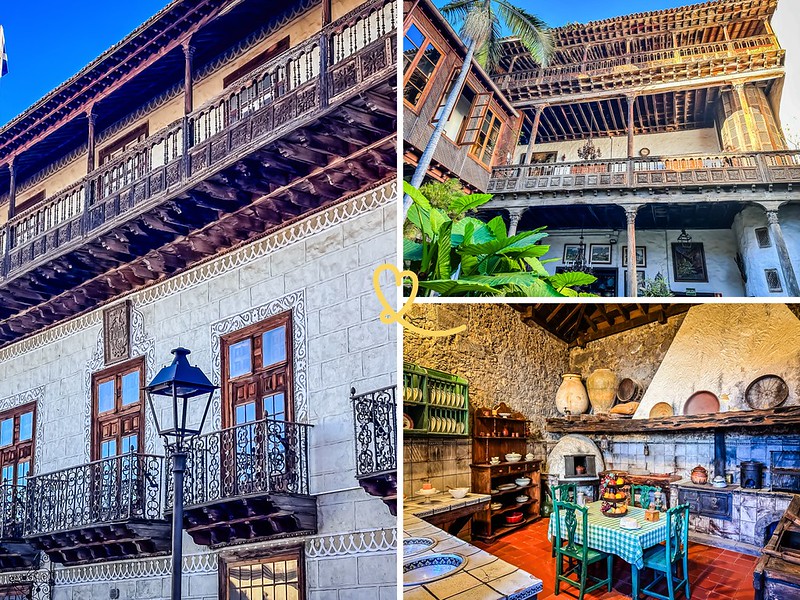
Stop by the Casa de los Balcones, a 17th-century stately home famous for its carved wooden balconies. We really liked its shaded Canarian patio and its teak porch, which had never been repainted. The house also houses a casa-museo and a workshop dedicated to calado canario, the traditional openwork embroidery of the Canary Islands.
In this article, check out our photos and all our tips for making the most of your visit to the Casa de los Balcones.
This opinion is completely independent, based on our experiences. We visited the region anonymously, making our own choices and paying our bills in full.
Why visit the Casa de los Balcones?
Is the Casa de los Balcones worth a visit? Our opinion:
Yes, the Casa de los Balcones is worth a visit. It’s one of the best things to do in La Orotava
We loved this house, built in 1632, for its Canarian patio and its teak wood porch, which has remained in its natural state for centuries. The museum on this floor reveals, room by room, the daily life of a well-to-do family, while the calado craftswomen carry on a local tradition right before your eyes.
>> Book your ticket

Why is the Casa de los Balcones famous?
The Casa de los Balcones, also known as Casa Fonseca or Casa Méndez-Fonseca, owes its fame primarily to its carved wooden balconies, which have become one of the most recognizable sights in La Orotava.
It is also considered the main shipbuilding center in the Canary Islands. Once we were there, we understood why it is considered a landmark in the history of tourism in the archipelago: as early as the 1960s, the family that owned it was already welcoming the island’s first visitors.

Our favorite moments
You’ll learn more about our tour in detail, but here are what we think are the highlights you shouldn’t miss:
- The Canarian patio, with its large teak balcony and the shade of its palm trees,
- The spiral staircase, whose central shaft is carved from a single piece of wood measuring 11.10 meters,
- The calado craftswomen, who embroider the tablecloths sold on site,
- Book your ticket

WHERE TO STAY IN Tenerife
Our independent picks for the accommodation of your dreams:
- Where to stay in Tenerife
- Our favorite: Hotel Corales Beach
Select by hotel type:
- 5-star hotels
- Best boutique-hotels
- Best hotels for families
- Best hotels in Seaside
- Best adults-only hotels
- Best all-inclusive hotels
- Top 4-Star Hotels
Select by city:

Directions: Casa de los Balcones, La Orotava
Where is the Casa de los Balcones located?
- In the historic center of La Orotava, Tenerife
- 3 Calle San Francisco, 38300 La Orotava
- Across from Casa Eladia Machado
- A few minutes’ walk from the Palacio Lercaro and the Iglesia de Nuestra Señora de la Concepción

How to get there?
La Orotava is located in northern Tenerife, in the hills above Puerto de la Cruz. By car, it takes about 15 minutes from Puerto de la Cruz. Buses operated by TITSA also connect the two cities. Once you’re in the historic district, we recommend continuing on foot: the streets are steep, but the house is very close to the main landmarks.
Parking
La Casa de los Balcones offers free parking to its visitors.
However, we found it easier to park outside the old town and then explore the city on foot.

OUR TIPS TO RENT A CAR IN Tenerife
- Compare prices on our preferred platform: DiscoverCars – one of the best rated sites.
- If you’re planning to explore the mountains, don ‘t take the smallest cars. A more powerful engine will be more comfortable.
- But don’t take too big a car either, as some roads are narrow.
- There’s a lot of demand and it’s an island, so book early.

Useful tips: duration, schedules, eating…
Best time to visit
The restaurant opens early, at 8:30 a.m. We recommend arriving early in the morning to enjoy the peaceful patio. On overcast days, the light is more even on the balconies, which makes it easier to take photos. On hot days, we enjoyed the shade on the patio and the natural coolness of the rooms.

Length of visit and main difficulties
The audio tour lasts 50 minutes. We recommend setting aside between 1 hour and 1 hour and 30 minutes to stroll around the patio, watch the artisans at work, and browse the shop. For our part, we stopped by Casa Eladia Machado, right across the street.
Access to the upper floor is via a narrow spiral staircase, which is not accessible to people with limited mobility. Their tour includes the ground floor and the wine press. The house does not have a luggage storage area: please avoid arriving with a lot of luggage.

Visiting with children
Children can use the audio guide on their own: all they have to do is enter the number shown on the signs. The kitchen, the period bathroom, and the fresco will give them a real sense of what life was like in the past. Help the younger children up the spiral staircase, which is quite narrow.

Schedules and rates
- The Casa de los Balcones is open every day from 8:30 a.m. to 6:30 p.m., except on the day of the Romería de La Orotava. Hours may vary depending on the season.
- The museum admission ticket includes an audio guide, which is available in French, among other languages. Expect to pay about 5 to 6€ for an adult. The following offers are also available:
- All-inclusive package: audio guide, admission to the museum and use of the restrooms, permission to take photos, one drink (beer, water, banana liqueur, or honey rum), and a tasting of almogrote and mojos
- Twin Ticket: Combined Ticket for Casa de los Balcones and Molino de Gofio del Hoyo
- Photos and videos: 1€, deducted from any purchase over 10€ and included with the audio-guided tour
- Visit the official website for more info here.
- >> Book your ticket

Catering
The house does not have a restaurant, but you are in the town of La Orotava, where there are several restaurants.

A facade and a patio carved from tea wood
Even before you step inside, the Casa de los Balcones sets the tone for the tour: Canarian pine wood, which is everywhere—from the street all the way to the heart of the courtyard.
The facade on Calle San Francisco and its carved balconies
First, we took the time to look at the facade from Calle San Francisco. The three-story building, commissioned in 1632, features a series of carved wooden balconies that gave it its name. This wood is tea, the resinous heartwood of the Canary Island pine, known for its strength.

Look up at the balustrades: the work of the artisans of that era—including the sculptor Andrés García Ramos—is evident in every detail. Flowerpots brighten up the upper floors. In our opinion, this façade alone encapsulates the unique character of the stately homes in La Orotava.
The Canarian patio and its large balcony-style veranda
Once inside, we discovered the patio, which is truly the heart of the house. As in most Canarian homes of this type, it organizes the layout of the rooms and promotes air circulation to alleviate heat and humidity.

Its large balcony-style gallery spans the top two floors; it rests on tall, polished tree trunks that serve as columns. Take a moment to sit in the shade of the palm trees and listen to the water in the fountain and the birds singing. We found it to be a welcome break in the middle of our day in northern Tenerife.
The indoor balcony, which opens onto the living room, dining room, kitchen, and pantry on this floor, is worth the visit on its own. We were surprised to learn that this teak wood has never been painted or treated: it still releases resin, centuries after it was installed.

You’ll notice the signs of age on the posts, though the delicacy of the carvings remains intact. The house presents it as a tribute to master carpenters throughout the ages, and we can see why this corner of the patio is one of the most photographed spots in the city.
The lagar, the old wine press at the back of the patio
At the back of the patio, be sure to check out the lagar, an authentic Canarian wine press. Until recently, this winery produced wines typical of the region, which are now sought after by wine enthusiasts. We found it interesting to discover this agricultural tool right inside a manor house: it serves as a reminder that wine production was part of daily life at the estate.

HAVE FUN IN TENERIFE: activities

The House-Museum: A Glimpse into the Private Life of a Wealthy Family in La Orotava
Opened to the public in 1990, the museum recreates the lifestyle of a wealthy Canarian family from the late 19th century, thanks to a large collection of objects that once belonged to the family.
The spiral staircase carved from a single tea tree trunk
The museum tour begins with a climb: a solid-wood spiral staircase, accessible directly from the patio, connects the floors of the house. Take a closer look at its central shaft, as it is a single piece of teak that is 11.10 meters high, with a diameter that remains constant along its entire length—16.5 centimeters.

We were impressed by the consistency of this barrel—something that’s hard to imagine without seeing it for yourself. The staircase was narrow, and we climbed it without rushing.
The living room-library and the dining room
Upstairs, you’ll enter the living room, where the family would entertain guests and continue their conversation after dinner—what the Spanish call *sobremesa*. We smiled when we learned that these visits played such an important role in the social lives of the well-to-do families of Villa de La Orotava that they were written down so they wouldn’t forget to return the visits.

The library contains many books in German, since the family was originally from Austria. Like the living room, the dining room gets direct natural light from the large balcony and the windows. Its original furnishings reflect a comfortable lifestyle without ostentation—a balance that we appreciated.

The kitchen, the pantry, and the bathroom
To get a sense of daily life in the house, head to the utility rooms. In the pantry, where food was stored, we spotted the ” fresquera,” a piece of furniture typical of Canarian homes that protected fresh produce from insects.

The kitchen retains all of its traditional features: water tanks, spaces for two ovens, utensils, and lebrillos. These large, hollow containers made of terracotta or metal were used, among other things, to knead gofio, a flour made from roasted grains and a staple food in the Canary Islands.

We finished up in the bathroom, which has also been preserved in its original condition: it really gives you a sense of how people used to bathe back then!
Calado Canario, Wine, and the Flavors of the Archipelago
Considered the leading artisanal calados distillery in the Canary Islands, the distillery also showcases local products.

Here we discovered what this establishment is famous for: calado canario. This openwork embroidery involves removing threads from the fabric to create patterns, which are then secured with a needle. La Orotava plays a central role in the history of this craft, and the Machado family has carried on the tradition ever since Eladia Machado founded her first workshop-school in 1940.
Watch their movements closely: they use the same technique as the town’s traditional caladoras, following patterns passed down from mother to daughter.

Extend Your Visit: Casa Eladia Machado and Palacio Lercaro
The Casa de los Balcones is part of a larger historic complex, which includes two other homes nearby that are open to the public.
Casa Eladia Machado, across the street
As you leave the house, cross Calle San Francisco to reach Casa Eladia Machado, formerly known as Casa del Turista. Built in 1590, at the end of the 16th century, it predates its neighbor. It was there that Eladia Machado, a visionary entrepreneur for her time, opened her first calados shop in 1940. She set up the zaguán, the entryway, to welcome visitors, while the rest of the property was used for sewing.
The Palacio Lercaro
The Palacio Lercaro is part of the same complex: Carlos Schönfeldt Machado, Eladia’s son, acquired it in 1994. The palace is designated a Site of Cultural Interest, both as a historic monument and as an ethnological site, thanks to its gofio mill, El Hoyo. Would you like to explore both places?

Hoyo Gofio Mill
The Twin Ticket combines a visit to the Casa de los Balcones and the Molino de gofio del Hoyo. We found this combination to be fitting, as it builds on our exploration of Canarian traditions. The palace is also home to the Restaurant du Palacio Lercaro, a convenient spot we recommend for lunch.

History in brief
From the home of a 17th-century captain to today’s artisan complex, the Casa de los Balcones has been home to many families and has seen many different chapters in its history. Here are the milestones in its history:
- 1632: Juana García Nieto and her husband, Juan de Castro Bazo—who would later become a captain and councilman—had a three-story building constructed. Woodcarver Andrés García Ramos, blacksmith Juan Bautista Cutiños, and carpenter Manuel de Vera are working on the project.
- Late 17th and 18th centuries: Since the couple had no children, the house passed to their nephew, Colonel Pedro Méndez de Castro, and then to the Fonseca family, who completed and embellished the residence.
- 1832: Mateo de Fonseca y Mesa succeeded his older brother Alonso, who had died without children.
- 1840: Upon Mateo’s death, the line died out. Following a court case, his widow, María Concepción García del Castillo y Martín, took possession of the house.
- 19th century: Antonio Díaz-Flores Cartaya, a businessman and art lover, purchased the mansion, which was then abandoned and in poor condition. His son inherited it, before Lorenzo Machado y Benítez de Lugo acquired the property.
- 1940: Eladia Machado, Lorenzo’s daughter, founded the first calados workshop and school, “Virgen de Candelaria,” in the house across the street.
- 1960s: As tourism began to take off in Tenerife, his son Carlos Schönfeldt Machado transformed the house into a craft center open to the public.
- 1990: The floor opened to the public as a museum, furnished to reflect the Canarian way of life in the late 19th century.
- 1994: Carlos Schönfeldt Machado acquired the Palacio Lercaro, which became part of the historic complex.

Frequently asked questions
How long does it take to tour the Casa de los Balcones?
The audio tour lasts 50 minutes. Plan on spending between 1 hour and 1 hour and 30 minutes so you can also enjoy the patio, the cellar area, and the gift shop.
Is it okay to take pictures inside?
Yes, for 1€, which is deducted from any purchase over 10€. This admission is included in the audio-guided tour and in the all-inclusive package.
Is the Casa de los Balcones accessible to people with limited mobility?
Partly. The upper level of the museum is accessed via a narrow spiral staircase, which is not accessible. The accessible tour includes the ground floor and the wine press.
PLAN YOUR TRIP TO tenerife
- Best of
What to do in Tenerife
Most beautiful towns and villages
Most beautiful beaches
Best natural pools
The most beautiful landscapes
Most beautiful roads
Amusement parks
Best excursions in Tenerife

- Practical advice
25 tips for a successful trip to Tenerife
How to get around
How to rent a car in Tenerife
Driving tips
Best excursions (coming soon)
Where to stay in Tenerife
Itineraries: 3 days – 4 days – 5 days – 6 days – 1 week – 10 days

- The must-dos
Dolphin watching in Tenerife
Teide National Park
Anaga Rural Park (coming soon)
La Orotava
Garachico
Village of Masca
Pyramids of Güimar