
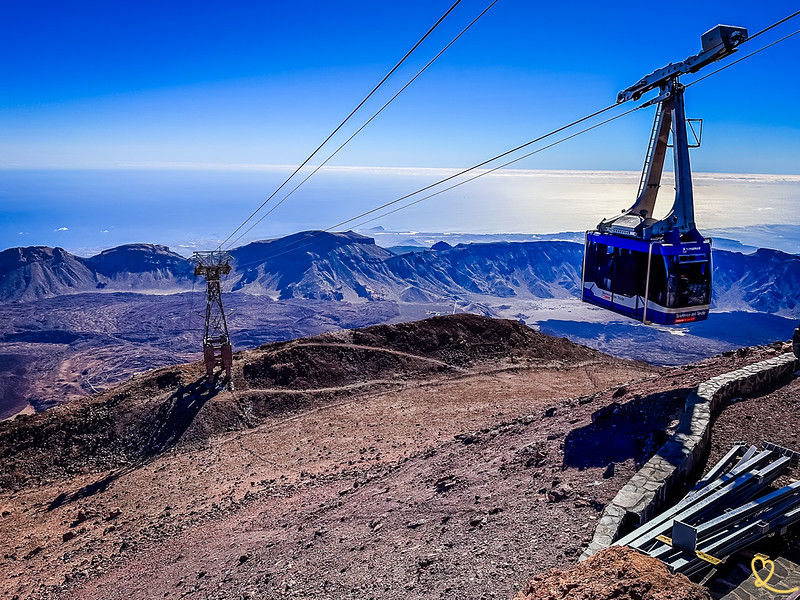
Want to soar above the clouds without lifting a finger? The Teide Cable Car takes you to the summit of Spain’s highest volcano in 8 minutes, in the heart of Teide National Park on Tenerife. We were blown away by how quickly we climbed and by the panoramic view that unfolded over the entire Canary Islands archipelago.
In this article, you’ll find some useful tips to help you prepare for your visit and have a wonderful time!
This opinion is completely independent, based on our experiences. We visited the region anonymously, making our own choices and paying our bills in full.
Why visit the Teide Cable Car?
Is the Teide Cable Car worth it? Our opinion:
Yes, the Teide Cable Car is worth a visit. In just a few minutes, we climbed more than 1,000 meters in elevation to find ourselves above the sea of clouds, facing a volcanic landscape straight out of another world. You don’t need to be in any particular physical condition to enjoy this exceptional view of Spain’s highest peak. It’s one of the best things to do in Tenerife, as we mention in our comprehensive guide to Teide National Park!

However, this is a cost that must be taken into account. And once you’re at the top, aside from the view, there’s nothing else worth seeing. If you’re on a tight budget or short on time, the drive through the park is still an amazing experience.
>> It is essential to book your tickets in advance here or to book a tour that includes the cable car: see the options
Why is the Teide Cable Car famous?
The Teide Cable Car is famous for providing the fastest access to the summit of Mount Teide, Spain’s highest peak at an elevation of 3,718 meters, and also the third-tallest volcano on the planet when measured from the ocean floor.
Since its opening in 1971, it has allowed millions of visitors to get a close-up view of this volcano, which towers over Teide National Park, a UNESCO World Heritage Site. Since 2024, the facility has been powered entirely by solar energy, without being connected to the power grid, making it the first cable car in the world to operate this way.

Our favorite moments
Here are our three favorite moments from our visit:
- The climb itself takes barely 8 minutes, with the view of the Las Cañadas caldera gradually opening up.
- Our arrival at La Rambleta, at an elevation of 3,555 meters, where the air grows thinner and the silence of the summit left a lasting impression on us.
- The 360° view from the observation deck, with the neighboring islands of the archipelago visible on the horizon on a clear day.

WHERE TO STAY IN Tenerife
Our independent picks for the accommodation of your dreams:
- Where to stay in Tenerife
- Our favorite: Hotel Corales Beach
Select by hotel type:
- 5-star hotels
- Best boutique-hotels
- Best hotels for families
- Best hotels in Seaside
- Best adults-only hotels
- Best all-inclusive hotels
- Top 4-Star Hotels
Select by city:

Directions and Map: Teide Cable Car, Tenerife
Where is the Teide Cable Car located?
- On the island of Tenerife
- In the heart of Teide National Park, on the TF-21 highway, at km 43,
- Travel time from Puerto de la Cruz: about 1 hour by car,
- Travel time from Costa Adeje: about a 1-hour drive
- Travel time from Santa Cruz de Tenerife: about 1 hour and 15 minutes by car
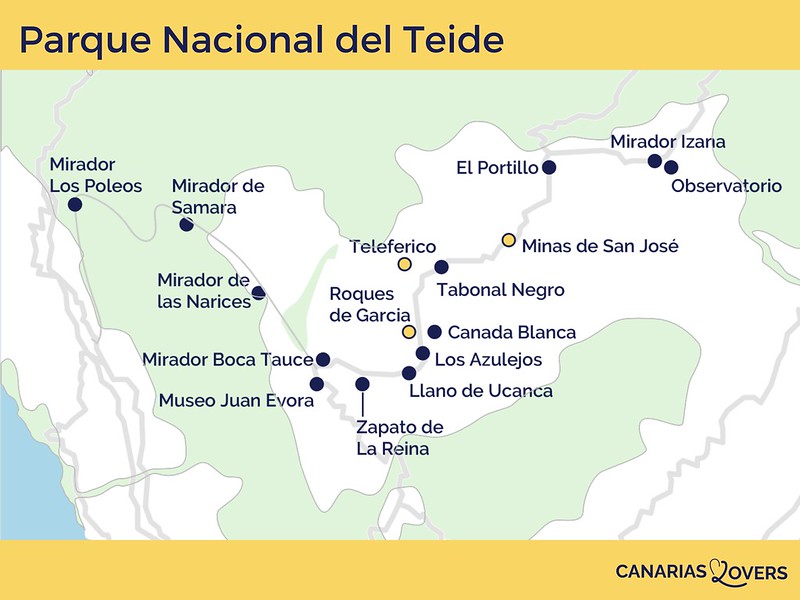
- Here is a map of the national park to help you find your way around, with the cable car (Teleferico) in the center:
How to get there?
There are several options available for getting to the Teide Cable Car. Depending on where you’re staying, you’ll take a different route: the TF-24 from Santa Cruz de Tenerife or La Laguna, the TF-21 from Puerto de la Cruz or La Orotava, the TF-38 from Los Gigantes, or the TF-21 from Playa de Las Américas and Los Cristianos via Vilaflor.
Bus route 348 connects Puerto de la Cruz to Las Cañadas del Teide, while route 342 serves the site from Playa de las Américas.

Parking
A large parking lot is available at the cable car base station, at an elevation of 2,356 meters. We recommend arriving early in the morning, as the number of parking spaces—though plentiful—is limited within this protected natural area. But since people are assigned to tickets at different times, cars leave regularly.

OUR TIPS TO RENT A CAR IN Tenerife
- Compare prices on our preferred platform: DiscoverCars – one of the best rated sites.
- If you’re planning to explore the mountains, don ‘t take the smallest cars. A more powerful engine will be more comfortable.
- But don’t take too big a car either, as some roads are narrow.
- There’s a lot of demand and it’s an island, so book early.

Useful tips: duration, schedules, eating…
Best time to visit
Plan on spending between 1 and 3 hours there, including waiting time and, if you’d like, a short walk. We recommend that you arrive early in the morning, right when it opens, to enjoy softer light and fewer crowds. In winter, it can get cold at the summit, so be sure to pack warm clothes—even if you’re setting out from a beach in Tenerife where the temperatures are much milder.

Length of visit and main difficulties
Access to the cable car and the lookout point is easy.
However, the ground around the upper station, outside the panoramic terrace, is very difficult to walk on: it is uneven volcanic terrain, so it’s best to wear sturdy shoes.

We’d also like to remind you that the altitude may cause mild shortness of breath or headaches in some visitors: it’s best to take it slow and listen to your body once you’re up there.

Schedules and rates
- The cable car operates daily, with hours that vary by season: from 9 a.m. to 5 p.m. in the winter and until 6:40 p.m. in the summer, with the last ride taking place 1 hour before closing.
- €42 for a non-resident adult and €21 for a non-resident child (round-trip, basic fare); residents of the Canary Islands are eligible for discounted fares.
- Visit the official website for more info here.
- It is essential to reserve your tickets in advance here
- or book a tour that includes the cable car: see the options

Guided tours
If you’d like to hike to the summit from the top of the cable car, you’ll need to obtain a permit in advance from the National Park. For added convenience, a guided tour to the Pico Viejo viewpoint is also available, as is a guided hike to the summit of Mount Teide, including tickets and permits.
Lodging
There is no lodging at the cable car station.
The Teide National Park and its surrounding area are home to a few hotels and lodging options.
Catering
There is a cafeteria at the cable car’s base station, at an elevation of 2,356 meters, making it one of the highest dining spots in Spain. You’ll also find a gift shop, restrooms, and an information desk there. We recommend stopping there before or after your climb, especially to help you acclimate gradually to the altitude.


The Ascent: From the Base Station to La Rambleta
Your tour begins at the base station, at an elevation of 2,356 meters—an already spectacular starting point in the heart of the Las Cañadas caldera. From there, head toward the summit along a route designed to make the most of the volcano’s terrain.
Departure from the base station, at 2,356 meters
We boarded at the Teide Cable Car base station, perched at an altitude of 2,356 meters and easily accessible by car from the TF-21 highway. The facility, which was modernized between 1999 and 2007, consists of two cabins that travel along a haul rope nearly 2.5 km long, guided by four 50-meter-high towers.

Each cabin can accommodate up to 44 passengers, although the number is usually limited to ensure everyone’s comfort.
Once inside the cabin, you begin the gentle ascent. The first thing you’ll notice are the solar panels at the lower station. Since 2024, the facility has been operating entirely on solar power, without being connected to the power grid, making it the first cable car in the world to do so!

8 minutes to get to La Rambleta
The cabin then ascends at a maximum speed of 8 m/s, covering a vertical distance of more than 1,200 m in just 8 minutes. We found this climb to be as quick as it was impressive: the landscape changes completely, shifting from volcanic scree at lower elevations to an almost lunar, rocky panorama.

You’ll see the ground transform beneath your feet, amid solidified lava flows and rocks in shades of ochre and reddish hues. The upper station, La Rambleta, is located at an elevation of 3,555 meters, on the shoulder of Teide’s summit cone. Please note that the cable car also operates outside its regular hours, particularly at sunset, for an even more intimate experience.

HAVE FUN IN TENERIFE: activities

La Rambleta, the upper station at 3,555 meters
Once you arrive at La Rambleta, you have several options. Not all of them require the same amount of effort or the same types of permits, so it’s important to plan ahead before purchasing your ticket.

View from the panoramic terrace
No special permission is required to enjoy the panoramic terrace at La Rambleta, which is open to all cable car ticket holders. We spent quite a while gazing down at the Las Cañadas caldera below.

You can also see the outlines of the neighboring islands standing out on the horizon on clear days: La Palma, El Hierro, and La Gomera to the west, and Gran Canaria and sometimes even Fuerteventura or Lanzarote to the east. It is also from this terrace that you will see the starting points of the various hiking trails, access to which depends on permits and the conditions of the day.


It’s time to book!
Compare everything: companies, prices, schedules and availability.
The Pico Viejo Viewpoint Trail
This nearly flat trail heads toward the western slope to reach a viewpoint overlooking the Montaña Chahorra crater—also known as Pico Viejo—which is about 800 meters in diameter and rises to an elevation of 3,104 meters. However, the ground, which is made up of large lava rocks, is not easy to walk on.
We have learned that the last recorded eruption of Mount Teide occurred in 1798, with lava flows spewing from the craters known as “Las Narices del Teide” for three months.

The trail offers a panoramic view of the island’s southern slope, with the large caldera framed by vertical rock walls, among which the massif of Montaña Guajara stands out. You’ll also be able to spot, in the distance, the coastal villages, the large resort complexes in southern Tenerife, and the island of La Gomera, which seems close enough to touch.
Climb to the crater with a permit
The Telesforo Bravo Trail, toward the summit of Mount Teide
If you want to hike to the true summit of Teide, at an elevation of 3,718 meters, you must obtain a free permit from the National Park administration; due to high demand, you should apply several months in advance. This trail, named Telesforo Bravo, starts at the upper station of the cable car and initially follows the route of the Mirador de La Fortaleza before branching off to the left to climb the steep slope of the peak.

The high altitude and the smell of sulfur from the numerous fumaroles make the climb difficult: we recommend that you climb slowly, taking short breaks to catch your breath. Once at the top, the yellow-green depths of the crater come into view, and on a clear day, the entire Canary Islands archipelago is visible in the distance. If arranging your own permits seems like too much of a hassle, a guided tour that includes cable car tickets, permits, and a guide is also available.

The “Science and Legend” Exhibition
Your cable car ticket includes admission to the “Science and Legend” exhibition, located at the visitor center at the base station. There, we learned about the main figures in Guanche mythology associated with the volcano, particularly Guayota, the deity who, according to ancient beliefs, personified Mount Teide. The exhibition also traces the last major eruption that occurred at the summit of Mount Teide, about 1,000 years ago, from both a scientific and a legendary perspective.

You can enhance your experience with the Teide Legend audio guide, available in 8 languages, including French, which also accompanies your visit to the rest of the National Park.
History in brief
The Teide Cable Car has a rich history spanning several decades, marked by a monumental construction project high in the mountains. Here are the key dates to remember:
- 1929: Andrés de Arroyo y González de Chávez, the project’s promoter, was impressed by the cable cars he had seen in Germany and Switzerland and decided to build a similar facility on Mount Teide.
- 1930: Engineer José Ochoa Benjumea drafted the initial construction plan.
- 1960: The final design was drawn up by engineers Miguel Pintor Domingo and Francisco Trujillo Armas.
- 1962–1971: Construction took 8 years. The materials were first transported by donkey, and then using a temporary cable car installed in 1967 to speed up the work.
- July 18, 1971: Official opening of the cable car, which began operating on August 2 of that same year.
- 1999–2007: Complete renovation of the facilities, including new cabins, cables, and towers.
- 2007–2008: Renovation of the tower structures without interrupting service; this project was awarded the Agustín de Betancourt Prize for the best civil engineering project.
- September 24, 2024: The cable car becomes the first in the world not connected to the power grid to operate entirely on solar power.

Frequently asked questions
Do you need to book tickets in advance for the Teide Cable Car?
Yes, reservations are required. Tickets are sold exclusively online, and we recommend booking several days in advance to ensure you get your time slot, especially during peak season. If you also wish to hike to the summit, you must obtain a separate permit in advance.
Is it possible to climb to the true summit of Teide?
A cable car ticket alone does not allow you to reach the summit of Mount Teide, at 3,718 meters. To do this, you must obtain a free permit from the National Park and take the Telesforo Bravo trail from the top station. Even without this permit, you can still explore the trails at the Mirador de La Fortaleza and the Mirador del Pico Viejo, which are open to the public.
Is it cold at the top of the Teide Cable Car?
Yes, it can get cold at the summit, especially in winter, even though Tenerife’s beaches have much milder temperatures at the same time of year. We recommend that you bring a warm jacket, regardless of the season, as well as appropriate footwear: the ground around the top station, outside the panoramic terrace, is still difficult to walk on.
PLAN YOUR TRIP TO tenerife
- Best of
What to do in Tenerife
Most beautiful towns and villages
Most beautiful beaches
Best natural pools
The most beautiful landscapes
Most beautiful roads
Amusement parks
Best excursions in Tenerife

- Practical advice
25 tips for a successful trip to Tenerife
How to get around
How to rent a car in Tenerife
Driving tips
Best excursions (coming soon)
Where to stay in Tenerife
Itineraries: 3 days – 4 days – 5 days – 6 days – 1 week – 10 days

- The must-dos
Dolphin watching in Tenerife
Teide National Park
Anaga Rural Park (coming soon)
La Orotava
Garachico
Village of Masca
Pyramids of Güimar