
Visiting Santa Cruz de Tenerife? Don’t miss a visit to the Canary Islands Military History Museum! Housed in the Fuerte de Almeyda, a remarkable fortification completed in 1884, this museum invites you to discover the evolution of island defense over the centuries. We particularly appreciated the richness of its collections and the authenticity of this place steeped in history.
In this article, you’ll find a selection of useful tips to help you prepare for your visit and enjoy your time with us.
This opinion is completely independent, based on our experiences. We visited the region anonymously, making our own choices and paying our bills in full.
Why visit the Canary Islands Military History Museum?
Is the Canary Islands Military History Museum worth a visit? Our opinion:
Yes, it’s worth the detour. In our opinion, it’sone of the best museums in the city. We were impressed by the richness and diversity of the collections, ranging from ancient weapons to more recent military vehicles. The immersive staging and meticulously restored casemates offer a real insight into the Canary Islands’ strategic past, and their key role in the archipelago’s military history.

Why is the Canary Islands Military History Museum famous?
Since its opening on February 1, 1988, the museum has gone from strength to strength, offering visitors ever richer collections. In addition to its permanent exhibition, the museum’s intense activity has made it a prestigious institution in the life of the city and the archipelago, interacting with the cultural bodies of the autonomous government, town halls, universities and educational centers. We have found that its reputation is also based on its exceptional location in a historic fortification and the quality of its educational presentations. This is one of the best activities in Santa Cruz de Tenerife.

Our favorite moments
You’ll find the details of our visit later, but we can’t resist sharing our favorites with you right now:
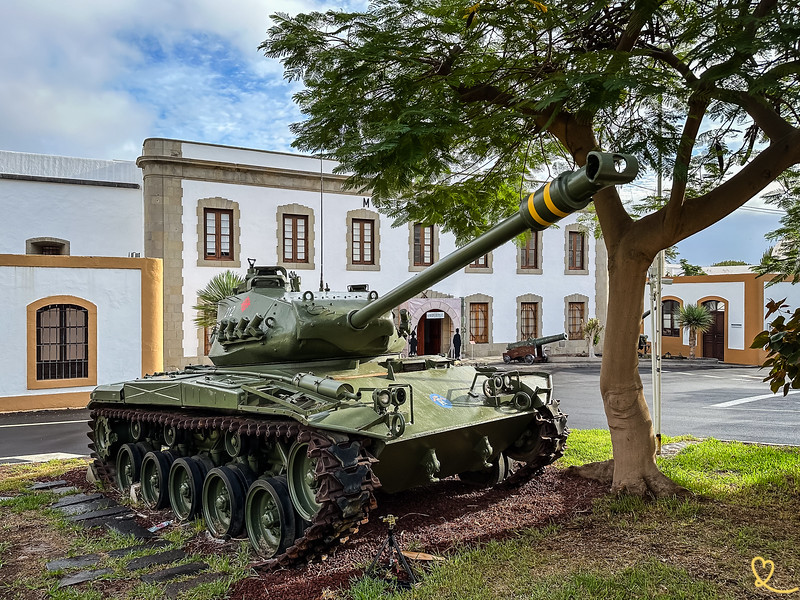
- The series of military vehicles on display in the inner courtyard: we were fascinated by the impressive tanks and helicopters that bear witness to the evolution of modern defense.
- The casemates: these underground caves, once used as shelters, plunged us into the atmosphere of the time, with their meticulous reconstructions.
- The exhibition dedicated to women in the army: we discovered the remarkable story of the first Canarian women to join the Spanish armed forces back in 1988.

WHERE TO STAY in Santa Cruz de Tenerife
Our favorites: neighborhoods and hotels
The old town of Santa Cruz
AC Hotel by Marriott Tenerife – Check photos and availability
North of downtown
Hotel Iberostar Heritage Grand Mencey – Check photos and availability
The Park Suites by IRES LAR – Check photos and availability

See our complete selection of the best hotels in Santa Cruz.
History in brief
Located in the Fuerte de Almeyda, the museum occupies a fortification built after the unsuccessful attack by the British fleet in 1797, led by Rear Admiral Horatio Nelson. Designed to reinforce the defense of Santa Cruz to the north and west, the fort was built on a strategic site already used for artillery since the XVIIᵉ century. Construction began in 1859 and was completed in 1884, just as technological advances were rendering its defensive structures obsolete. Transformed into a museum, the site opened to the public on February 1, 1988, and was officially inaugurated on July 25.

Access and map: Military History Museum of the Canaries, Santa Cruz de Tenerife
Where is the museum?
The museum is located at 2 Calle San Isidro in Santa Cruz de Tenerife.
- North of the center of Santa Cruz de Tenerife
- West of the Santa Cruz Ferry Terminal
- 10min walk from Parc García Sanabria
- 15min walk from Plaza de España

OUR TIPS TO RENT A CAR IN Tenerife
- Compare prices on our preferred platform: DiscoverCars – one of the best rated sites.
- If you’re planning to explore the mountains, don ‘t take the smallest cars. A more powerful engine will be more comfortable.
- But don’t take too big a car either, as some roads are narrow.
- There’s a lot of demand and it’s an island, so book early.

How to get there?
There are several options for getting to the museum. It can be reached on foot from downtown in less than 15 minutes. By car, take the Rambla de Santa Cruz or TF-11 north, then turn into Calle San Isidro, which leads directly to the museum entrance. If you prefer public transport, several local TITSA lines serve stops less than a 5-minute walk away. The “Almeyda” bus stop is directly opposite the museum entrance. For timetables and itineraries, click here.

Parking
Parking is available on site, making it easy to get to the museum by car.

DISCOVER Santa Cruz de Tenerife

Useful tips: duration, schedules, eating…
Best time to visit
Overall, the museum is sparsely frequented, ensuring a peaceful visit. However, we recommend a weekday morning visit for greater peace and quiet, rather than a weekend visit. And don’t forget that part of the tour takes place outdoors. Please note that the museum closes early in the afternoon from 3pm, so plan your visit accordingly. We appreciated the serene atmosphere of the morning, which allowed us to observe the collections at our own pace.

Length of visit and main difficulties
Allow 1h to 1h30 to fully enjoy the different sections of the museum.
Most of the site is accessible to people with reduced mobility, with ramps and adapted toilets. However, some areas, such as casemates, can be difficult to access. We found it easy to move between indoor and outdoor spaces, although you’ll need good shoes to explore the fortifications.

Advice on how to visit
When you arrive, you’re bound to notice the armored vehicles on display in the courtyard, but wait until the end of the tour to take a look around (this was our favorite part). We recommend you start by entering the museum and taking a tour of the various rooms. Then continue with the view of the Santa Cruz ferry port as you leave the museum and climb to the top of the fortifications. Continue with a tour of the casemates, accessible from the inner courtyard. Round off your visit with a tour of the inner courtyard, featuring military vehicles and impressive weapons of war. This organization enabled us to enjoy a progressive and coherent visit.


Visiting with children
A number of games and models make the visit even more fun for children. We particularly enjoyed the interactive game “Nelson’s Challenge”, in reference to British commander Horatio Nelson’s attempt to conquer Tenerife. This educational approach allows youngsters to immerse themselves in history while having fun at the same time. The military vehicles in the inner courtyard also attract the attention of children, who can observe them up close.

Schedules and rates
The museum is free and open:
- Tuesday to Friday, 9 a.m. to 3 p.m.
- Weekends and public holidays from 10 a.m. to 2 p.m.
Visit the official website for more info here.

Guided tours
An audio guide is available via a QR code to be scanned on your smartphone. It is available in 4 languages: Spanish, English, German and French. We found this tool rich in information, available in both text and audio (robotic voice) formats. You can explore the collections at your own pace, with detailed explanations of each section of the museum.

Catering
Cafetería La Pérgola is on site for a gourmet break. For more inspiration, check out our article on the best restaurants in Santa Cruz de Tenerife.

Diving into the military history of the Canaries
The giant model of the Battle of Santa Cruz de Tenerife
We were captivated by this model made in the 1980s and recently restored by the Tenerife Model Makers Club. It combines sound and moving lights to reproduce the main events of the attempted British invasion of the city in 1797. This episode is one of the most significant events in the history of Santa Cruz de Tenerife.

You can relive the conquest attempt of British commander Horatio Nelson, who sought to seize the capital in search of great riches. This meticulous reconstruction illustrates the Spanish victory over the British navy, a decisive moment for the archipelago. We appreciated the realism of this presentation, which helped us better understand the strategic issues of the time and the bravery of the city’s defenders.

Between conquest and exploration: a journey into the past of the Canary Islands
The Canary Islands were first populated by Berber communities from North Africa, established on the archipelago as early as the Iᵉʳ century BC. The European conquest, begun in 1402 by the Frenchman Jean de Béthencourt, lasted almost a century, ending in 1496. After fierce resistance from the native populations, the islands were definitively attached to the Crown of Castile following the conquest of Tenerife. In the room dedicated to this period, we particularly appreciated the display of 15th-century weapons, armor and military objects used by the Castilian conquerors during the siege of Tenerife: a striking ensemble that brings to life this significant episode in the archipelago’s history.

Once peace had been restored, the Canaries became a strategic stopover on the major sea routes. The archipelago was home to Christopher Columbus, Magellan and Elcano, testifying to its key role in the rise of the Great Discoveries. The showcases dedicated to this period plunged us into the atmosphere of the first transatlantic voyages, with vintage maps, navigation instruments and ship models. From the XVIᵉ to the XVIIIᵉ century, the islands were the target of numerous attacks by pirates and European powers, a context that the museum recreates through models of fortifications, uniforms and artillery.

Explore military collections
Artillery and weapons through the centuries
This section features an impressive collection of cannons, shells, bombs, revolvers, rifles and firearms from different eras. Of particular note is the “Hercules” cannon, a 16th-century aculebriar cannon cast in Flanders, which protected the coast of Tenerife until the 19th century. You can also admire a fine collection of military medals and historical coins. The uniforms on display include the outfit of a female military medical orderly, a testament to the presence of women in the army. We were struck by the diversity of the pieces on display, each telling a different story in the evolution of combat and defense techniques.

Symbols, communication and military life
This part of the museum features a rich collection of flags, including 2 English flags captured during the Battle of Santa Cruz de Tenerife. We discovered cartography and navigation elements, as well as communications equipment: radios, telephones, telemetry and transmission equipment. You’ll also notice period furniture, historic photographs and evocative paintings. Model boats complete the presentation, illustrating the boats used in different periods. We appreciated the way these everyday military objects revealed the living conditions of soldiers.

Visit the courtyard and exterior of the museum
A unique view of the Port of Santa Cruz
The museum’s strategic location offers a remarkable view of the Port of Santa Cruz. We took advantage of this panoramic view to observe the ferries and the coast from the heights of the fortifications. It’s easy to see why the site was chosen as a defensive site. The view of the modern port facilities contrasts with the ancient military architecture, creating an interesting dialogue between past and present.

The restored casemates
These underground caves, once used as shelters, complete the immersion into the military world of the past. We were impressed by their meticulous layout: they house models, firearms and artillery. You’ll also discover reconstructions with mannequins that bring these confined spaces to life. These well-restored casemates give an idea of the conditions in which soldiers protected themselves during attacks.

Military vehicles in the open air
The museum’s inner courtyard features a remarkable collection of military vehicles. We were fascinated by the impressive tanks, helicopters and armored vehicles that bear witness to the evolution of military technology. You can also see a food cart, once pulled by 2 mules and designed to carry cold meals, spare clothes, bread and cooking utensils. This singular piece illustrates the military logistics of yesteryear and the challenges of field supply. We appreciated being able to move freely around these machines to examine the details. This open-air exhibition is a highlight of the visit, particularly appreciated by fans of mechanics and modern military history.

Subscribe to our Newsletter
- Get away from it all with Region Lovers’ beautiful destinations!
- Once a month
- Advertising-free

Frequently asked questions
Does the museum host temporary exhibitions?
Yes, and in particular an exhibition on the First Canarian Women in the Army. Women have only been allowed to join the Spanish armed forces since February 1988. Among the first 27 women to enlist that year were Mercedes Mila and Maria de los Reyes Mendoza Trujillo, the first female parachutist in 1992. This exhibition highlights the courage and determination of these pioneers, who paved the way for other generations of military women.

How do you relive the Battle of Santa Cruz on July 25?
Every year, the town of Santa Cruz de Tenerife commemorates the Battle of July 25, 1797 – a major episode in local history – with an immersive historical re-enactment. Organized by theAsociación Histórico Cultural – La Gesta del 25 de julio de 1797, with the support of the municipality and the Canary Islands Military History Museum, this event immerses visitors in the atmosphere of the period. For more information on the event, times and locations, visit the association’s official website here.
PLAN YOUR TRIP TO tenerife
- Best of
What to do in Tenerife
Most beautiful towns and villages
Most beautiful beaches
Best natural pools
The most beautiful landscapes
Most beautiful roads
Amusement parks
Best excursions in Tenerife

- Practical advice
25 tips for a successful trip to Tenerife
How to get around
How to rent a car in Tenerife
Driving tips
Best excursions (coming soon)
Where to stay in Tenerife
Itineraries: 3 days – 4 days – 5 days – 6 days – 1 week – 10 days

- The must-dos
Dolphin watching in Tenerife
Teide National Park
Anaga Rural Park (coming soon)
La Orotava
Garachico
Village of Masca
Pyramids of Güimar